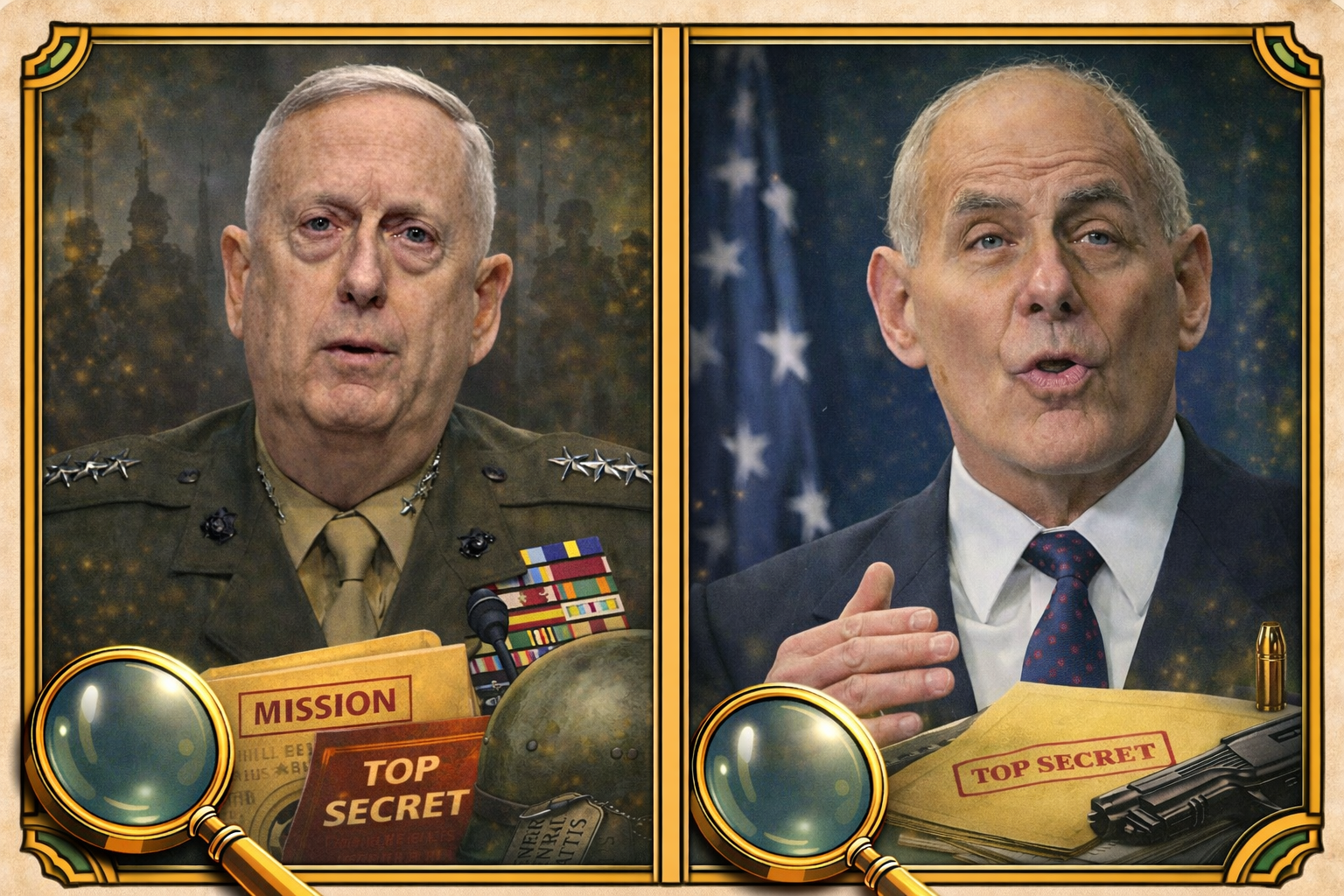
Every institution has people who believe in it more than it deserves.
The military has more of them than most.
Two of them walked into this building in 2017 believing that forty-plus years of service — of real service, the kind measured in deployments and casualties and decisions that cost lives and kept more — meant something inside these walls.
It meant something.
Just not what they thought it meant.
Mattis left clean.
Kelly left complicated.
Both of them – left right.
[Every word will be tested.]
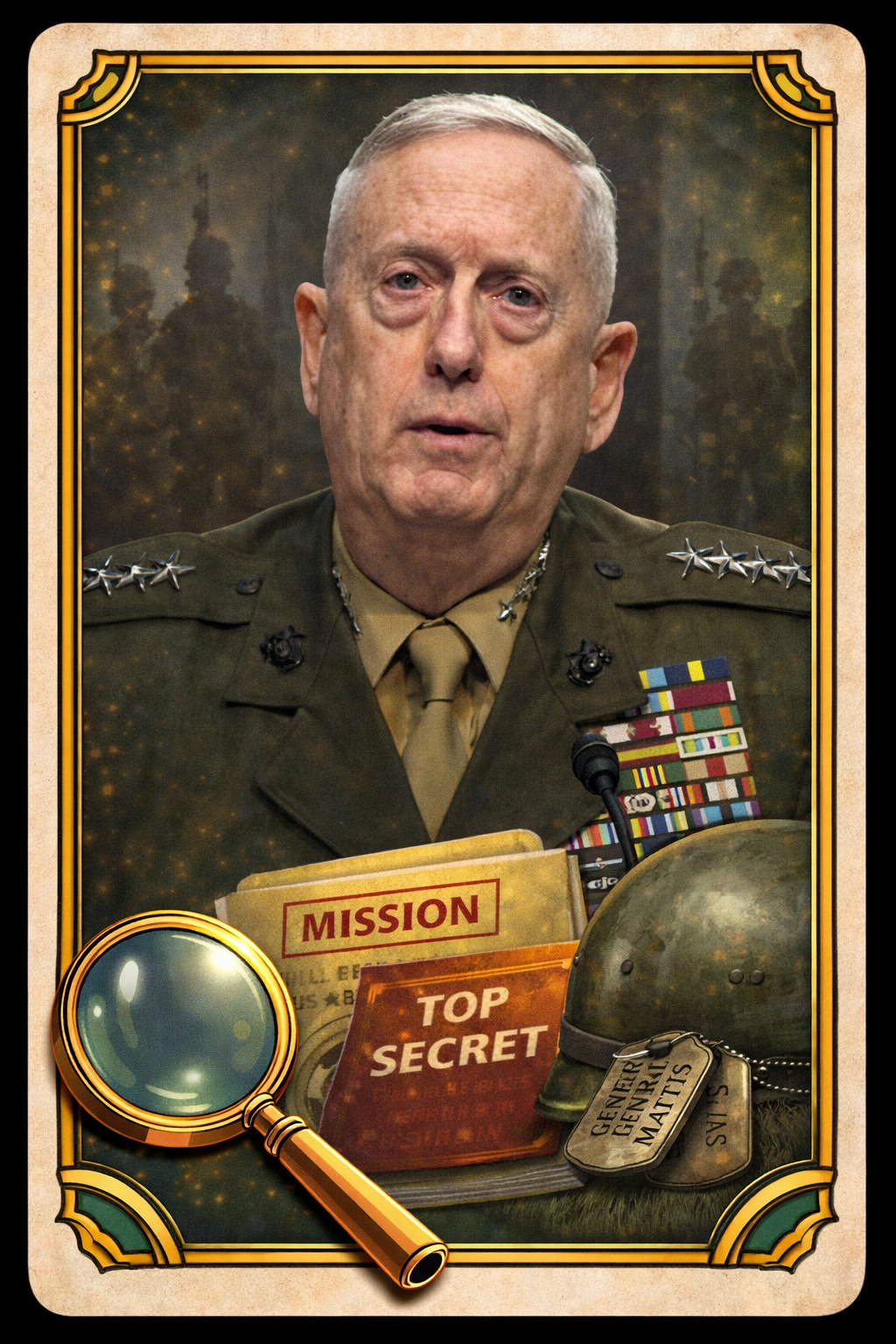
James Mattis spent forty-four years in the United States Marine Corps.
Four-star general. Every level of command. Gulf War. Iraq. Afghanistan. He ran Central Command overseeing military operations across the Middle East, Central Asia, and East Africa. His call sign was Chaos — not because he created it, because he understood it.
His reading list was distributed to subordinates. Marcus Aurelius. Thucydides. Clausewitz. Roughly nine hundred volumes covering military history, philosophy, and the nature of power. He had annotated copies of most of them.
Trump called him the closest thing to General George Patton that we have.
This is not an accurate comparison on any historical, tactical, or temperamental level.
It is the kind of thing that gets said when a man who learned about war from movies meets a man who learned about war from war.
Mattis accepted the nomination anyway.
Mattis ran the Pentagon methodically. Seriously. With an absolute insistence on process, on allied relationships, on the institutional frameworks that had kept American military power coherent for seventy years.
He pushed back. Quietly. In the room rather than in public. When Trump proposed withdrawing from NATO, Mattis explained. When Trump proposed military options that violated the laws of armed conflict, Mattis explained. When Trump wanted to use the military as a domestic political prop, Mattis resisted.
He won some of these arguments.
He lost more than he won.
[And then one day the line moved.]
December 19th, 2018.
Trump announced, via Twitter, the immediate withdrawal of all American troops from Syria. No consultation with allies. No consultation with military commanders. No consultation with the Secretary of Defense.
Mattis learned from Twitter.
He went to the Oval Office.
The meeting was short.
Mattis's resignation letter is two pages.
It is the most widely read resignation letter in American political history.
It does not mention Trump by name.
It does not need to.
It states that he is resigning because the President deserves a Secretary of Defense whose views are more aligned with his. It then lists what Mattis's views actually are — on alliances, on adversaries, on the men and women in uniform.
It was read aloud on the Senate floor by a Republican senator who was crying.
It was read aloud by a Democratic senator who was also crying.
[This will not happen again.]
Three months later, Trump reversed the Syria withdrawal decision.
American troops remained.
Mattis had been right.
This was not acknowledged.
Nine months after the resignation. The letter, by this point, had been framed and hung in offices across the Department of Defense, the State Department, and approximately forty percent of the national security community's living rooms. The producer's note has not been similarly displayed.
In June 2020, when Trump threatened to invoke the Insurrection Act to deploy active duty military against American citizens protesting in American cities, Mattis broke his public silence.
He called it a naked assault on democracy.
He endorsed Biden.
He did not use the word moron.
He didn't need to.
[Cohen. Quieter than he's been all night.]
[He has not yet met this thing.]
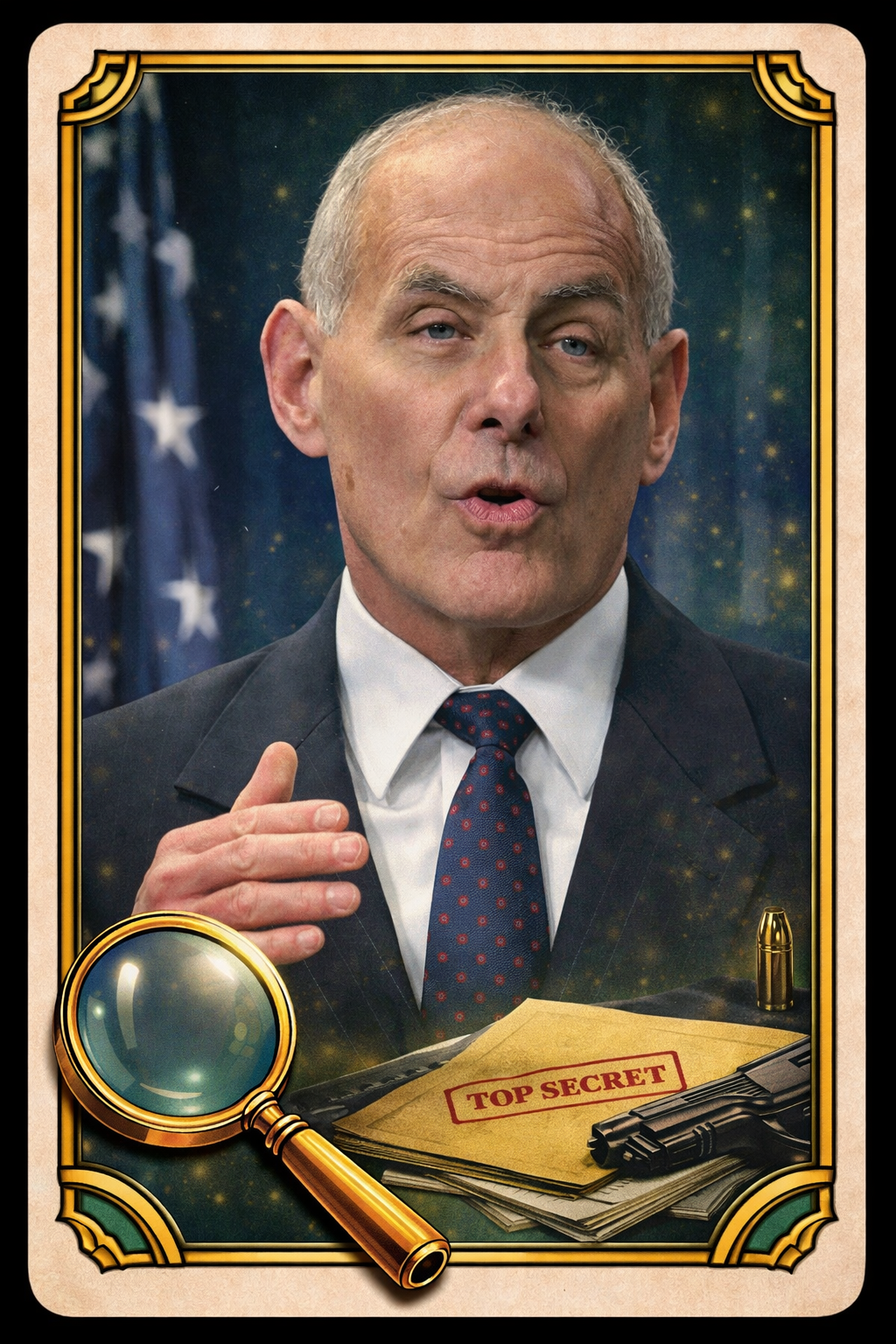
John Kelly spent forty-five years in the United States Marine Corps.
Four-star general. Gulf War. Iraq. The war on terror. He lost his son Robert in combat in Afghanistan in 2010 — First Lieutenant Robert Kelly, killed by a landmine at age twenty-nine.
The father attended the ceremony.
The father did not break.
The father went back to work.
This is the man Donald Trump hired to bring order to the West Wing.
Kelly imposed order.
This is not in dispute. For approximately six months — autumn and winter of 2017 into 2018 — the West Wing ran with something approaching coherence. Access to the president was controlled. The schedule was honored. Staff knew who reported to whom.
[And then the president started calling people directly. On his cell phone. At night. Without telling anyone.]
[And that was kind of the end of that.]
The fundamental problem with being Chief of Staff to Donald Trump is structural and has nothing to do with Kelly's capabilities.
The president did not want a Chief of Staff.
The president wanted a Chief of Staff the way a river wants a dam.
They cannot coexist.
One of them has to win.
Kelly lasted longer than almost anyone expected.
He also said things — privately, to colleagues, in conversations that eventually found their way to journalists — that were considerably more candid than his public posture.
He called Trump an idiot.
He said he was the most flawed person he had ever met.
He said Trump didn't understand alliances, the press, or the oath of office.
He said all of this after he left.
Kelly's departure in December 2018 was not a firing.
It was a resignation. Slow. Mutual. Exhausted.
Trump announced it on Twitter — naturally — saying Kelly had done a great job.
Kelly did not hold a press conference.
Kelly did not issue a statement.
Kelly walked out of the West Wing and did not look back.
[It is a regular door.]
[It sounds like any other door.]
[It isn't.]
Six words. Five hundred and seventy-one days. One son buried in Afghanistan. Six words.
In 2020 Kelly said Trump was the most flawed person he had ever known.
This, coming from a four-star Marine general who spent decades dealing with warlords, insurgents, and hostile heads of state.
In 2024 he said Trump was a fascist — specifically, by the dictionary definition — and unfit for office.
He said this clearly. On the record. By name.
He also said that if Trump's former chiefs of staff had spoken up together before the 2020 election, it might have made a difference.
They did not speak up together before 2020 or since.
[He lives with this.]
[Cohen stands.]
[He stops.]
[The room is empty.]
[The folder is on the table.]
[The bad lighting remains.]