Flynn believed in the movement.
Bannon believed in the theory.
The next two believed in something considerably more old-fashioned.
They believed in the job.
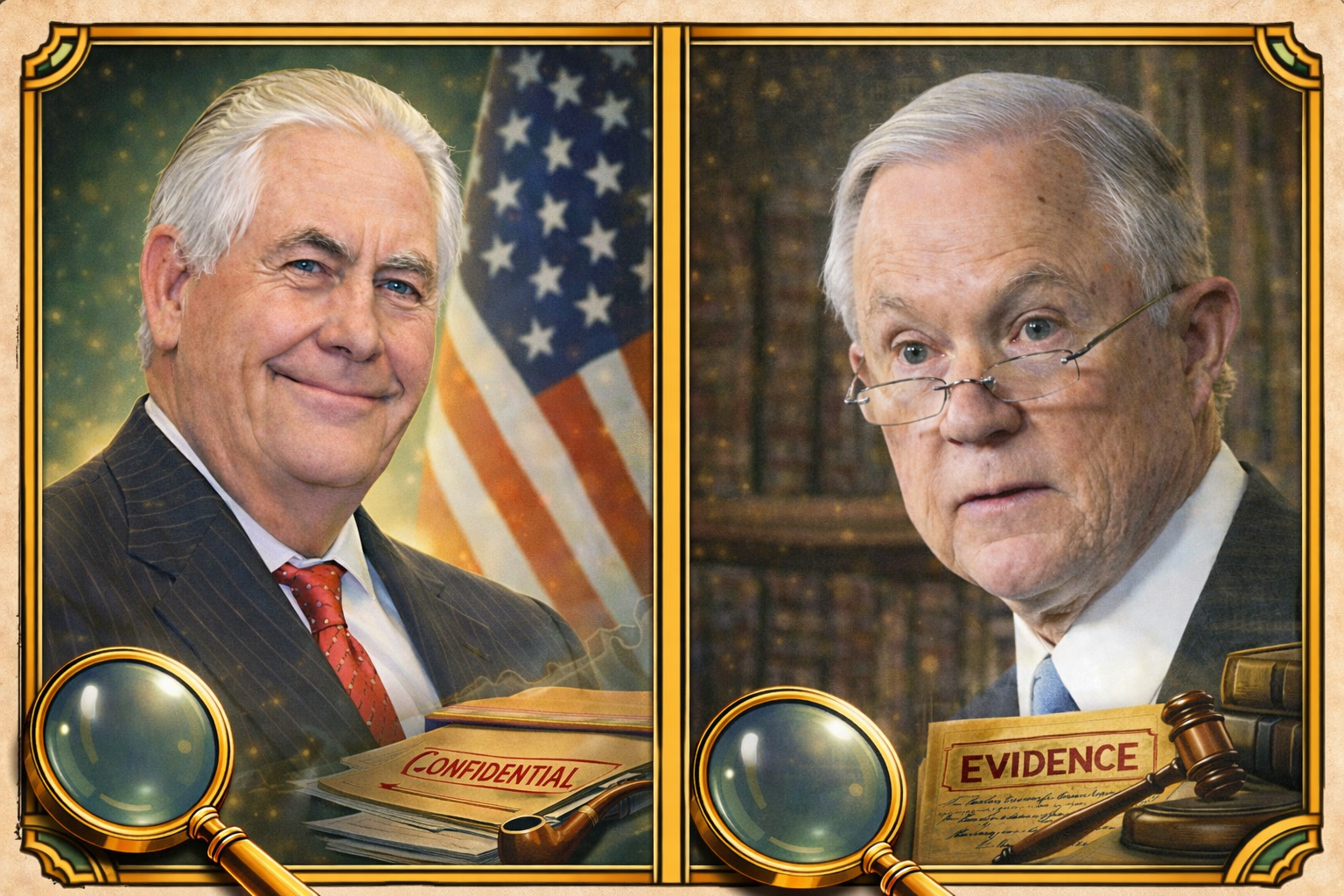
Rex Tillerson believed the Secretary of State was the Secretary of State — that the title meant what it said, that the role carried what it had always carried, that forty years of running the largest company on earth had prepared him for the largest diplomatic posting in the world.
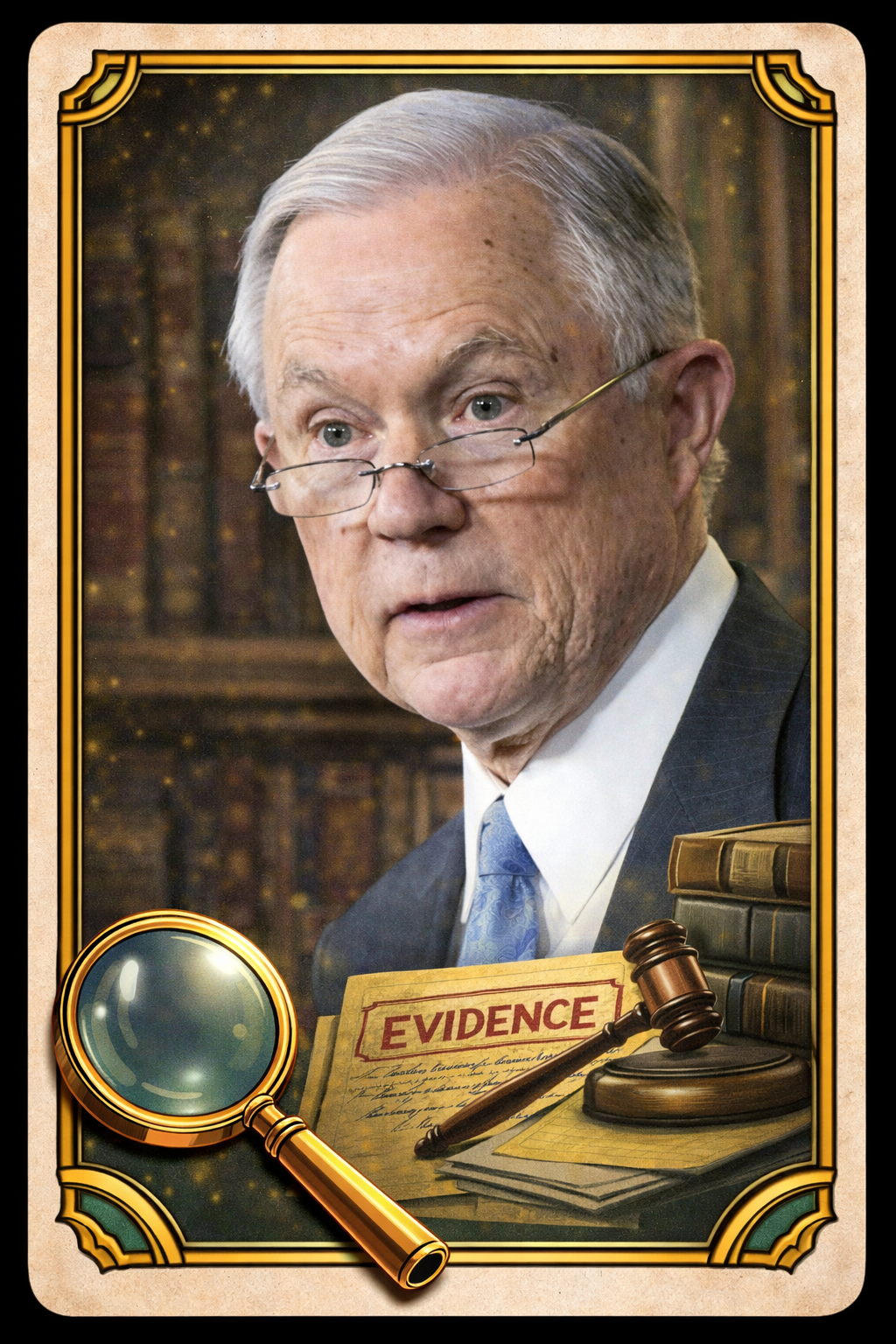
Jeff Sessions believed the Attorney General was the Attorney General — that the law meant what it said, that the oath meant what it said, that the institution he had spent his career serving would function the way institutions are supposed to function when the right people are in them.
Both of them were wrong.
Not about their capabilities.
About what the job was.
The job was never the job.
The job was the show.
And the show had no use for people who confused the two.
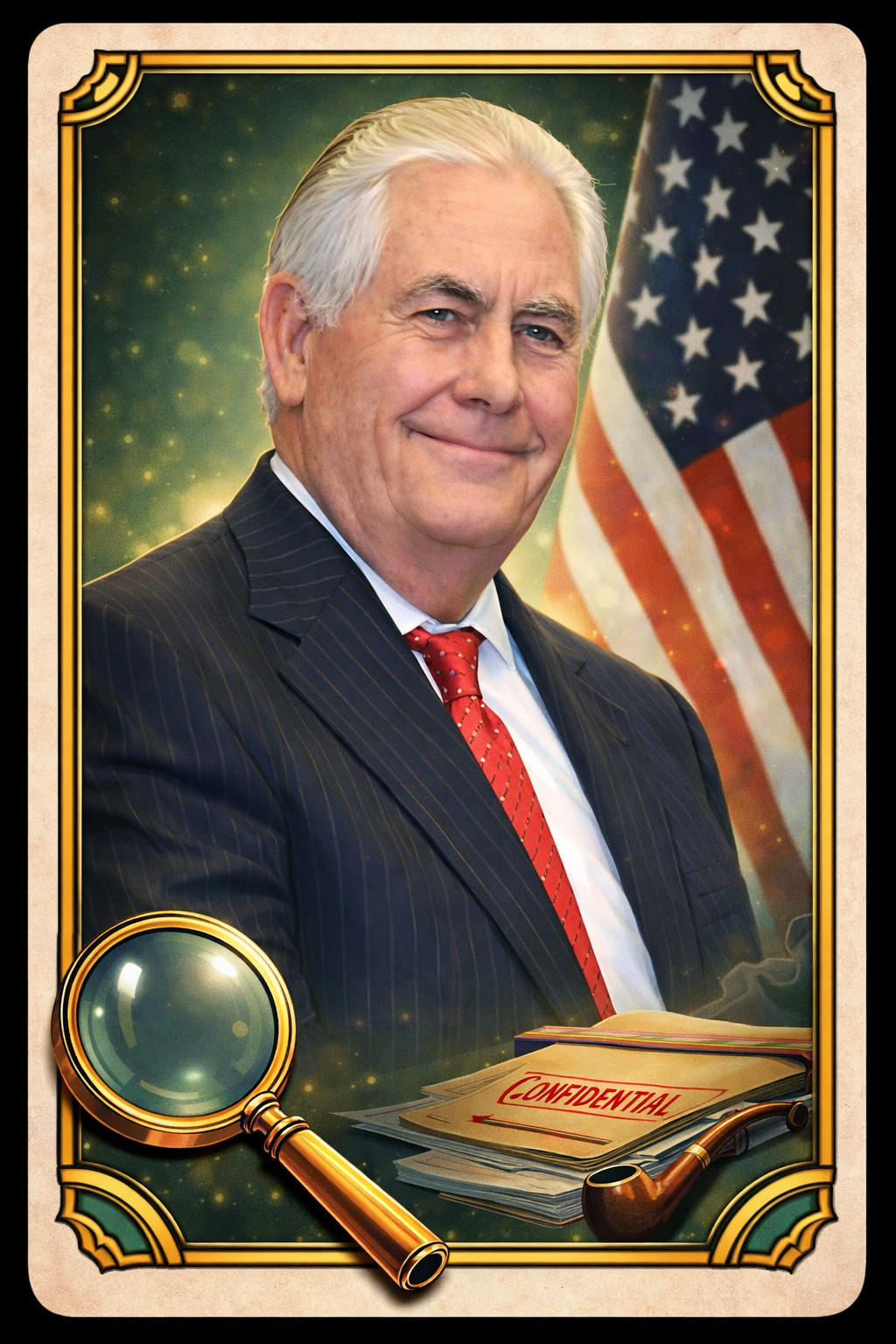
[The job is not Foggy Bottom. The job is the show. These are not the same thing.]
Rex Tillerson spent forty-one years at Exxon Mobil. He started as a production engineer in 1975 and became CEO in 2006. Under his leadership Exxon was, depending on the year, the largest or second largest company in the world by revenue — a privately held sovereign state in everything but name, operating across the globe with the quiet efficiency of a machine that has never once needed to hold a press conference about its feelings.
He had never held public office. He had never testified before Congress, navigated a Senate confirmation, or explained American foreign policy to an allied nation that was not also an oil customer.
None of this disqualified him.
In December 2016, Donald Trump named Rex Tillerson Secretary of State.
The qualifications cited were: he's a dealmaker, he knows the world, he's tough, he got along with Putin.
Tillerson's audition was his biography.
He didn't campaign for the role. He was identified — through a network of Republican establishment figures that included Condoleezza Rice and Robert Gates, both of whom had consulting relationships with Exxon — and presented to Trump as the kind of man the job required.
Trump met him once.
Trump offered him the job. Tillerson accepted.
In the history of this particular show, this remains one of the most consequential decisions ever made in a gold elevator.
Tillerson arrived at the State Department and immediately did something that surprised everyone who had been watching the transition with growing alarm.
He tried to do the job.
He reorganized the department. He pushed for diplomatic solutions. He maintained back channels with allies who were confused and alarmed by the new administration's rhetoric. He told the truth in congressional testimony even when the truth was inconvenient. He said, publicly, that America's commitment to its allies was not conditional — a statement that directly contradicted positions the host had taken on camera.
He also called the president a moron.
Not publicly. In a meeting of the National Security Council's cabinet members.
The specific quote, per subsequent reporting, was fucking moron.
[The room understands what has just happened.]
[The so-called moron, watching from the Oval Office, understands what has just happened.]
The clock, which had begun quietly in the background, gets louder.
On March 13th, 2018, Rex Tillerson was in Nairobi, Kenya.
He was doing his job.
At 8:44am Washington time, Donald Trump posted on Twitter:
Tillerson learned he had been fired from Twitter.
He was on another continent.
He was on the toilet.
Thirteen words of thanks for four hundred and twenty-two days of service. Tillerson did not call Trump a moron again. Publicly.
In a December 2018 interview, Tillerson said Trump was undisciplined, doesn't like to read, and refuses to read his intelligence briefings.
He said this calmly. In complete sentences.
He then returned to Texas.
He has not been back.
[Cohen briefly.]
[He will continue meaning it long after it stops being reciprocated.]
Jefferson Beauregard Sessions III was born in Selma, Alabama, in 1946, and entered public life as a federal prosecutor before becoming Attorney General of Alabama and then a United States Senator, a position he held for twenty years.
He was, in the Senate, reliably and specifically conservative on the issues that mattered most to the emerging Trump coalition — immigration restriction, trade skepticism, law and order — before those positions had a movement behind them. He was America First before America First had a name and a hat.
He was also, in 1986, rejected for a federal judgeship by a Republican-controlled Senate Judiciary Committee after testimony that he had made racially insensitive remarks as a prosecutor in Alabama.
This was noted at his confirmation hearing for Attorney General.
It was not enough to stop the confirmation.
He was confirmed 52-47.
[He would not look that way again for quite some time.]
Sessions didn't audition.
He invested.
The February 2016 endorsement was not a calculation. It was a conviction. He had been saying the things Trump was saying — on immigration, on trade, on the forgotten American worker — for twenty years in a Senate where nobody was listening. Trump was saying them to arenas of seventy thousand people.
Sessions recognized the moment. He climbed on the stage. He put on the hat.
[One of them is about to get exactly what he wanted.]
[One of them is not.]
Sessions was confirmed as Attorney General on February 8th, 2017, and immediately set about doing what he had spent twenty years wanting to do.
Enforcing the law. Strictly. Consistently. Without apology.
Immigration enforcement tightened. Drug prosecution guidance shifted. The department's posture on criminal justice hardened. Sessions believed — and this belief was entirely consistent with everything he had ever said or done in public life — that the job of the Attorney General was to enforce the laws of the United States as written.
He was good at it.
The problem was not his performance.
The problem was a single decision made on March 2nd, 2017.
On March 2nd, 2017, Jeff Sessions recused himself from all investigations related to the 2016 presidential campaign.
He did this because the Department of Justice's own ethics officials told him he had to.
He did this because the law required it.
He did this because he was, whatever else might be said about him, a lawyer who understood that the appearance of conflict required the reality of recusal.
[The man in the Oval Office does not care about ethics regulations.]
[He cares that his Attorney General will not be able to protect him from what is coming.]
[And what is coming is Robert Mueller.]
The recusal led directly to the appointment of Special Counsel Robert Mueller.
Mueller led directly to two years of investigation.
Two years of investigation led directly to the single longest public humiliation of a cabinet official in the history of American executive branch television.
Trump called Sessions "weak."
Trump called him "beleaguered."
Trump called him "Mr. Magoo."
[The irony of this particular insult, deployed by this particular person, has been left as an exercise for the reader.]
Sessions submitted his resignation on November 7th, 2018 — the day after the midterm elections.
At the request of the President.
He had survived six hundred and thirty-one days of public humiliation, private contempt, tweets, insults, nicknames, and the specific indignity of watching the man you gave your first endorsement to treat your loyalty as a character flaw.
He had enforced the law.
He had done the job.
He had recused himself when recusal was required.
Twenty words. Six hundred and thirty-one days. The math is not complicated.
Jeff Sessions returned to Alabama.
He ran for his old Senate seat in 2020.
Trump endorsed his opponent.
Sessions lost the primary.
He lost the seat he had held for twenty years — the seat he gave up to become Attorney General — because the man he endorsed before anyone else would touch him decided that loyalty had an expiration date and Sessions's had passed.
[He has not been seen wearing the hat.]
[Cohen. Quiet.]