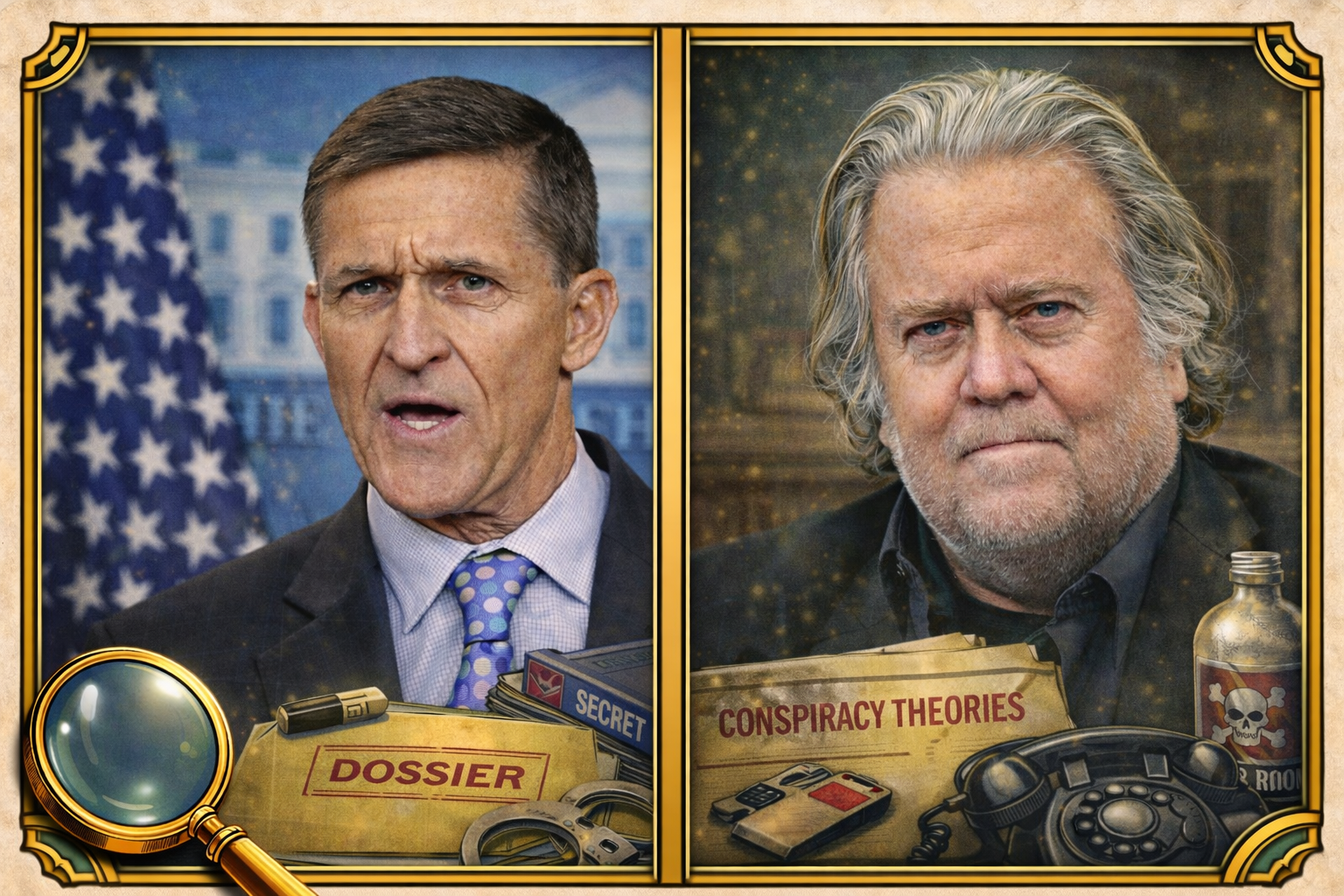
There is a category of contestant that every reality show eventually produces.
Not the ambitious one. Not the desperate one. Not the one who just wants the exposure and a career on TV.
The True Believer.
The one who arrives not because they want what the show is offering but because they genuinely think the show needs them. That without them the whole enterprise collapses.
That they are not competing — they are completing.
They were there first. They built the stage before anyone else knew there was going to be a performance.
The Apprentice: Washington Edition had two of them in its first season.
One lasted twenty-four days.
One lasted two hundred and four.
Between them they defined everything that followed — not because they succeeded, but because they failed in the two most instructive ways a person can fail in that building.
One believed too completely.
One understood too clearly.
Neither of them saw it coming.
Neither of them has entirely accepted it yet.
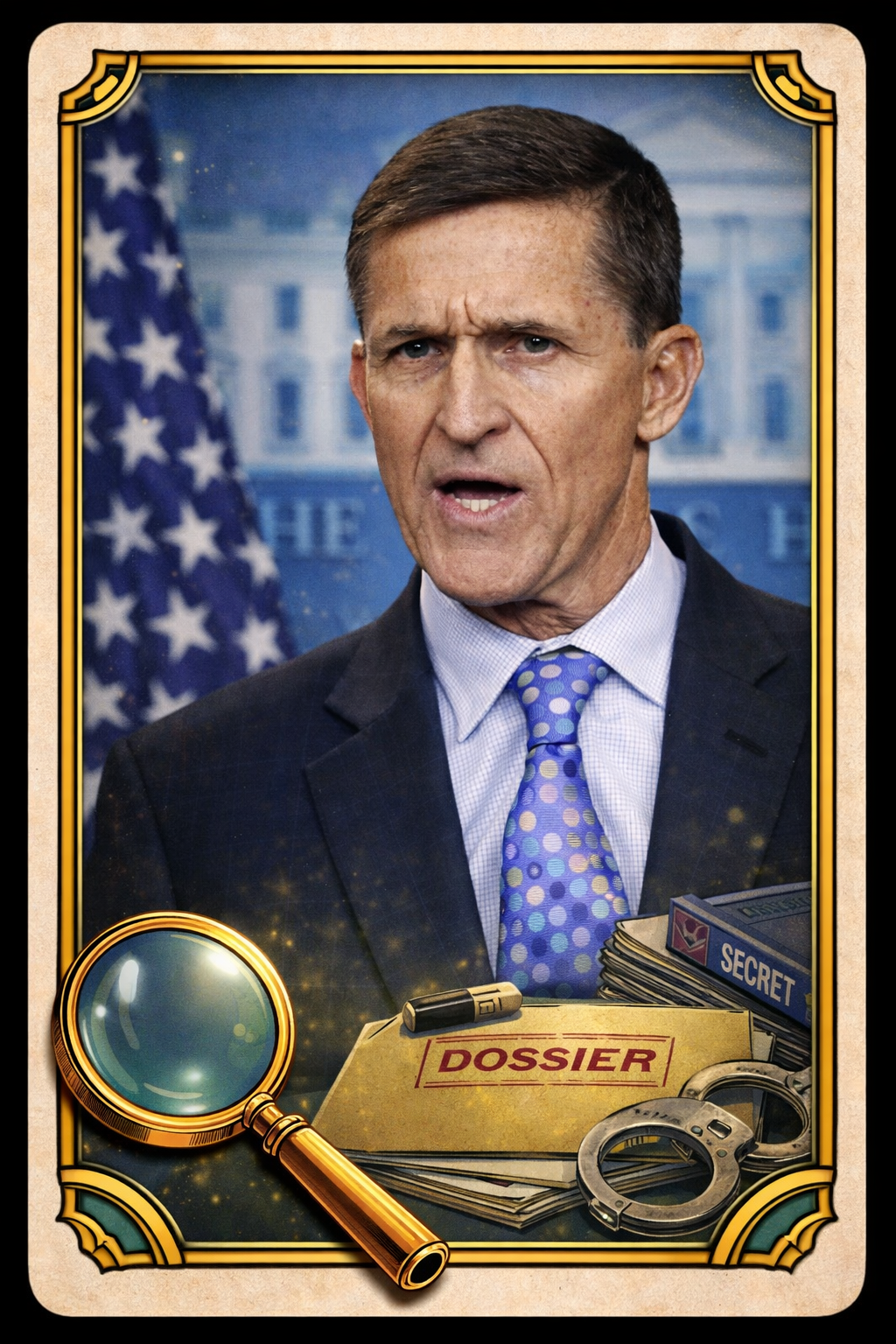
Michael Flynn arrived in Washington the way a lot of dangerous things arrive — with impeccable credentials and a grievance.
Retired Lieutenant General. Former Director of the Defense Intelligence Agency. Three combat deployments. A genuinely distinguished military career that ended badly when the Obama administration pushed him out of the DIA in 2014 — officially for management issues, unofficially for a management style that colleagues described as, and this is a direct quote from multiple contemporaneous accounts, Flynn facts. Meaning things Michael Flynn stated as facts that were not, in the conventional sense, facts.
He landed at the Trump campaign in 2015 like a heat-seeking missile finding the only room in American politics that didn't require its facts to be facts.
He was home.
[Flynn grins. This is the grin of a man who has just discovered he can conduct an orchestra.]
[What nobody in that arena is thinking about — what nobody will think about for another six months — is that while Michael Flynn is leading chants about locking up political opponents for mishandling classified information, Michael Flynn is on the payroll of the Turkish government. Unregistered. As a foreign agent. Which is itself a crime. A fact-shaped fact, as opposed to a Flynn fact.]
[The crowd roars.]
Flynn was named National Security Advisor on November 18th, 2016.
He was warned.
Specifically, explicitly, formally warned.
Sally Yates — then Deputy Attorney General — went to the White House counsel in January 2017 and said, in terms that required no interpretation: Michael Flynn has been having conversations with Russian Ambassador Sergey Kislyak about sanctions. He is lying about those conversations to the Vice President. He is potentially compromised. This is a problem.
The White House sat on this information for eighteen days.
Flynn continued to serve as National Security Advisor for eighteen days.
On day nineteen he resigned.
Flynn pleaded guilty to lying to the FBI in December 2017.
Then he tried to withdraw the plea.
Then he pleaded guilty again.
Then the Justice Department, in a move that produced a response from approximately every former federal prosecutor in the United States, moved to drop the charges.
Then the judge appointed an outside counsel to review the dismissal.
Then Flynn was pardoned by the President of the United States on November 25th, 2020. A full pardon. For all offenses. Known and unknown. Committed or that might be committed. The legal equivalent of a produce aisle where you pay for whatever might be in the bag without looking inside.
Michael Flynn did not go quietly into that good night.
Michael Flynn went to Gettysburg, Pennsylvania, where he took a public oath — with a group of QAnon adherents — to a movement whose central belief was that a secret cabal of satanic cannibalistic pedophiles was running the American government and that Donald Trump had been chosen by God to destroy them.
He started a podcast.
He sells merchandise.
He speaks at conferences where the PowerPoint slides reference biblical prophecy and the seating chart looks like a fire code violation.
He has never stopped believing.
The belief, at this point, is doing a lot of work.
[Cohen looks at the camera.]
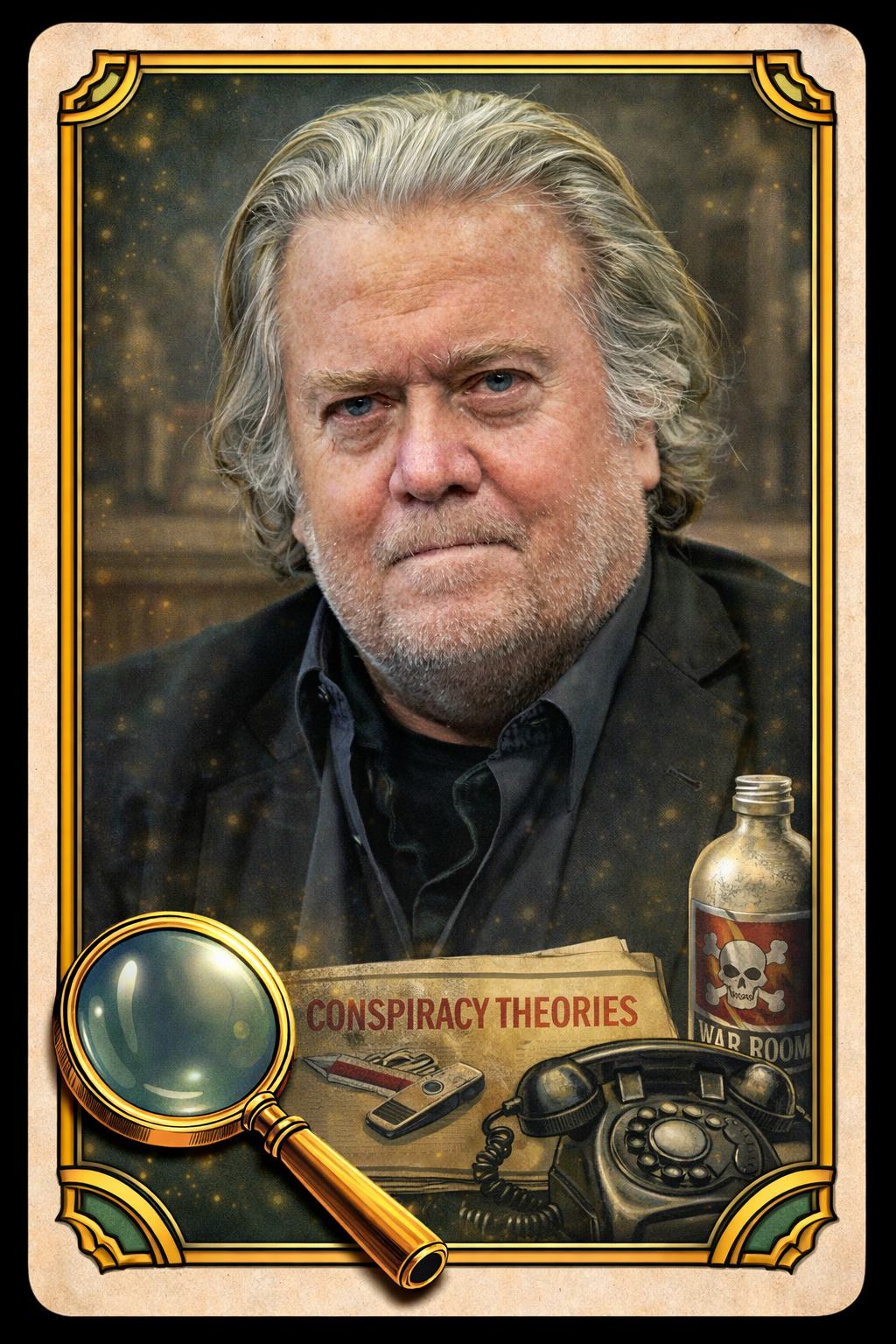
Steve Bannon came to the Trump campaign in August 2016 from Breitbart News, which he had built into the internet's most reliable distributor of nationalist grievance, white identity politics, and headlines specifically engineered to provoke bursts of reverberating righteous indignation.
Before Breitbart he had been a Goldman Sachs banker. A Hollywood producer. A Navy officer. A man of remarkably varied appetites and a reading list that he deployed like a weapon — Guénon, Evola, Strauss and Howe — dropping names in interviews to signal that what looked like populist rage was actually a coherent civilizational theory.
Whether it was a coherent civilizational theory or extremely well-read populist rage was a question that journalists spent four years trying to answer and never quite did.
What was not in question: Steve Bannon knew exactly what he was doing.
Almost until the moment he didn't.
Bannon didn't audition for the show.
He wrote the show.
The nationalist economic message that defined the 2016 campaign — trade wars, immigration restriction, America First, the forgotten working class as political constituency — that architecture was substantially Bannon's. He arrived at the campaign six months before the election and immediately understood something the professional political class had spent eighteen months missing:
The audience wasn't watching the same show everyone else thought was on.
[He has been preparing for this room for twenty years.]
Bannon arrived in the White House with a title — Chief Strategist — that had never existed before and was created specifically for him. He was placed on the National Security Council's Principals Committee, a move that produced the specific facial expression of horror in every career national security professional who heard about it.
The NSC Principals Committee is where the Secretary of Defense, the Secretary of State, the Director of National Intelligence, and the Chairman of the Joint Chiefs sit down to discuss existential threats to the United States.
Steve Bannon was now at that table.
Steve Bannon, who had most recently been running a website.
The show has a rule — we've established this — about visibility.
You can be effective. You can be powerful. You can be, in the estimation of serious people, the most influential figure in the building.
What you cannot be is the most famous figure in the building.
That position is taken.
Bannon appeared on the cover of Time magazine in February 2017 under the headline THE GREAT MANIPULATOR.
[The clock, at this moment, begins.]
The leaks followed. Bannon briefed Michael Wolff for what became Fire and Fury — the book that described the Trump White House as a chaos factory staffed by people who privately believed the president was unfit for office. Bannon's quotes were vivid, specific, and career-ending.
On the Trump Tower meeting with Russian operatives he said, on the record, that it was treasonous.
Trump's statement on Bannon's departure did not use the phrase Great American Patriot.
It did not use the phrase loyal friend.
It said:
It was just the hammer, no wrap.
Steve Bannon was indicted in August 2020 for defrauding donors to a private border wall fundraiser called We Build The Wall, through which he and associates allegedly diverted hundreds of thousands of dollars for personal expenses.
He was pardoned on January 20th, 2021. Trump's last hours in office.
He now hosts a podcast called War Room which broadcasts daily to an audience of millions and which has been described, by people who study these things professionally, as one of the most influential vectors of right-wing political messaging in the United States.
He was also held in contempt of Congress for defying a January 6th subpoena.
He was convicted.
He reported to federal prison in July 2024.
He was released.
He is currently, as of this writing, podcasting.
The movement, it turns out, does not require a West Wing office.
It never did.
[Cohen sets down the folder.]